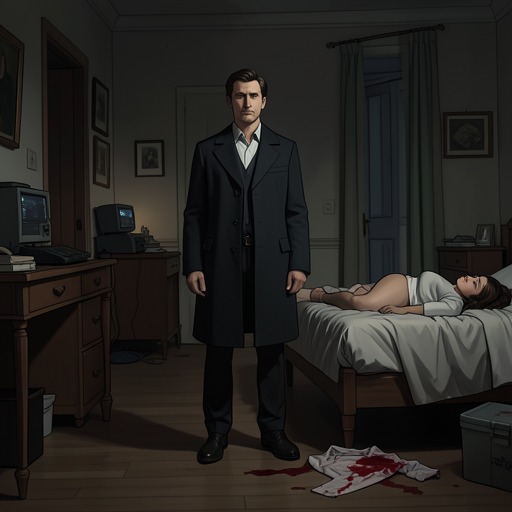
Marianne’s Abduction and Murder
Hold TightMarianne’s Abduction and Murder is the coordinated crime Nash and Pietra carry out after drugging Marianne at a bar in Teaneck, New Jersey. They take her in a stolen van, question her about a tape, and kill her; afterward, they use her phone to create a false account of her absence and alter her appearance before leaving her in a Dumpster in Newark’s Fifth Ward. The episode makes disappearance itself part of the crime: a message sent under Marianne’s name offers a plausible explanation, while the staging of her body is designed to obstruct recognition. Yet Nash’s final words to her turn the killing toward another loss, revealing that his grief for Cassandra is not separate from the violence but a source of resolve within it.
Lure and Capture
The abduction begins with Marianne being guided toward an emergency exit. At first, she interprets the back door as a practical route out of the building and welcomes the fresh air, hoping it will make her feel better. That ordinary expectation is overturned outside: a white van with tinted windows is waiting, its rear doors open. The man who seizes her is wearing a bushy mustache, and he pushes her into the vehicle while Pietra, disguised with straw-colored hair, drives.
The concealments are removed once Marianne is inside. Nash takes off the false mustache, identifies himself by greeting her by name, and demands to know where the tape is. Pietra’s wig is likewise an element of their disguise, not her actual appearance. The details transform what might have seemed like an opportunistic assault into a planned operation: one partner keeps Marianne occupied, the other prepares the vehicle and controls the route. The car’s later use of altered plates and the pair’s subsequent return to disguises extend that planning beyond the initial capture.
The circumstances of the lure are explained later. Pietra had put a drug in Marianne’s drink while Nash held her attention with a discussion of the Cain-ape theory. That account clarifies why Marianne was vulnerable when she was led toward the exit, and connects the conversation, the drink, and the waiting van as parts of one coordinated scheme. The pair had begun with her in Teaneck; the apparent change of setting from the bar to the vehicle is also the transition from deception to captivity.
Interrogation and Death
Once in the van, Nash questions Marianne about the tape and uses violence against her. His purpose changes during the assault: he initially seeks information, and, after deciding she has told him everything, he kills her. The account presents this not as a sudden loss of control but as deliberate violence directed toward a specific objective and then continued after that objective has been met. The distinction matters to the event’s sequence: extracting what he wants does not bring Marianne’s ordeal to an end.
Nash’s conduct is calculated, and the narration emphasizes his familiarity with how to inflict harm while protecting his own hands. He also pauses near the end to establish that Marianne is still conscious and to secure her attention. Rather than offering an explanation or asking another question, he asks her to pass a message to Cassandra: he misses her. Marianne’s death follows. The message reveals the emotional logic Nash attaches to his actions, but it does not make the killing an act of mercy or lessen his responsibility. The tenderness implied by an intimate message is set against the calculated murder of the person forced to hear it.
A Manufactured Disappearance
After the killing, Nash takes Marianne’s BlackBerry Pearl and uses it to impersonate her. A photograph of her daughter appears on the screen before he opens the email function. He writes to selected contacts that Marianne is going to Los Angeles for a few weeks and will be in touch when she returns, signs the message with her name, and copies it into two additional emails. The device’s ability to send messages makes it a tool for extending the abduction into the lives of people who might otherwise notice her absence.
Nash’s reasoning depends on what he believes the recipients already expect. He judges that people who know Marianne will not search too urgently because she has a pattern of disappearing and later reappearing. The lie therefore does not need to account for every detail of her life; it needs only to echo a behavior that can make her continued absence seem familiar. This fabricated trip to Los Angeles gives the disappearance a stated destination and duration, while the promise to get in touch postpones the moment when silence might appear alarming.
The emails also show the asymmetry of the crime. Marianne’s name and contacts remain available, but she cannot control the message that represents her. The phone’s photograph of her daughter briefly places a family connection on the screen, while Nash proceeds to send the false account of her departure. The action is practical concealment rather than a search for information: the emails are intended to discourage a prompt search, not to communicate Marianne’s actual circumstances.
Staging and Significance
Nash and Pietra use a stolen van whose license plates have been changed to complicate efforts to trace it. They take Marianne’s clothes off and dress her in fresh garments from a shopping bag; Pietra had selected the pink top and very short leather skirt. Nash places a bandana in Marianne’s hand and closes her fingers around it. These choices construct a misleading appearance around the body, presenting her as a street worker rather than as the missing woman whose contacts have just received a false email.
They leave Marianne in a Dumpster in Newark’s Fifth Ward, an area the narrative associates with street prostitution and murder. Nash has altered her appearance, but does not remove all her teeth. He reasons that a dental identification would be difficult and slow, while removing every tooth would make the effort to conceal who she was too obvious. The plan is therefore not to make recognition impossible; it is to delay it and obscure the circumstances in which she died. That distinction gives the staging its practical purpose and links the body’s condition to the false digital trail.
Before leaving, Nash puts his mustache back on and Pietra restores her wig, although nobody is nearby. He looks down at Marianne’s body and thinks of Cassandra. His grief weighs on him, yet also gives him strength. That closing turn holds the episode’s central contradiction: Nash is capable of intimacy and sorrow, but those feelings do not interrupt his violence. Marianne is made to carry his message to Cassandra, then abandoned beneath a disguise intended to make her harder to identify. The murder thus joins a search for evidence, a calculated attempt to evade discovery, and Nash’s unresolved bereavement in a single sequence.